Safety First: How to Properly Position and Secure Your Refuse Collection Truck Before Maintenance
Maintenance
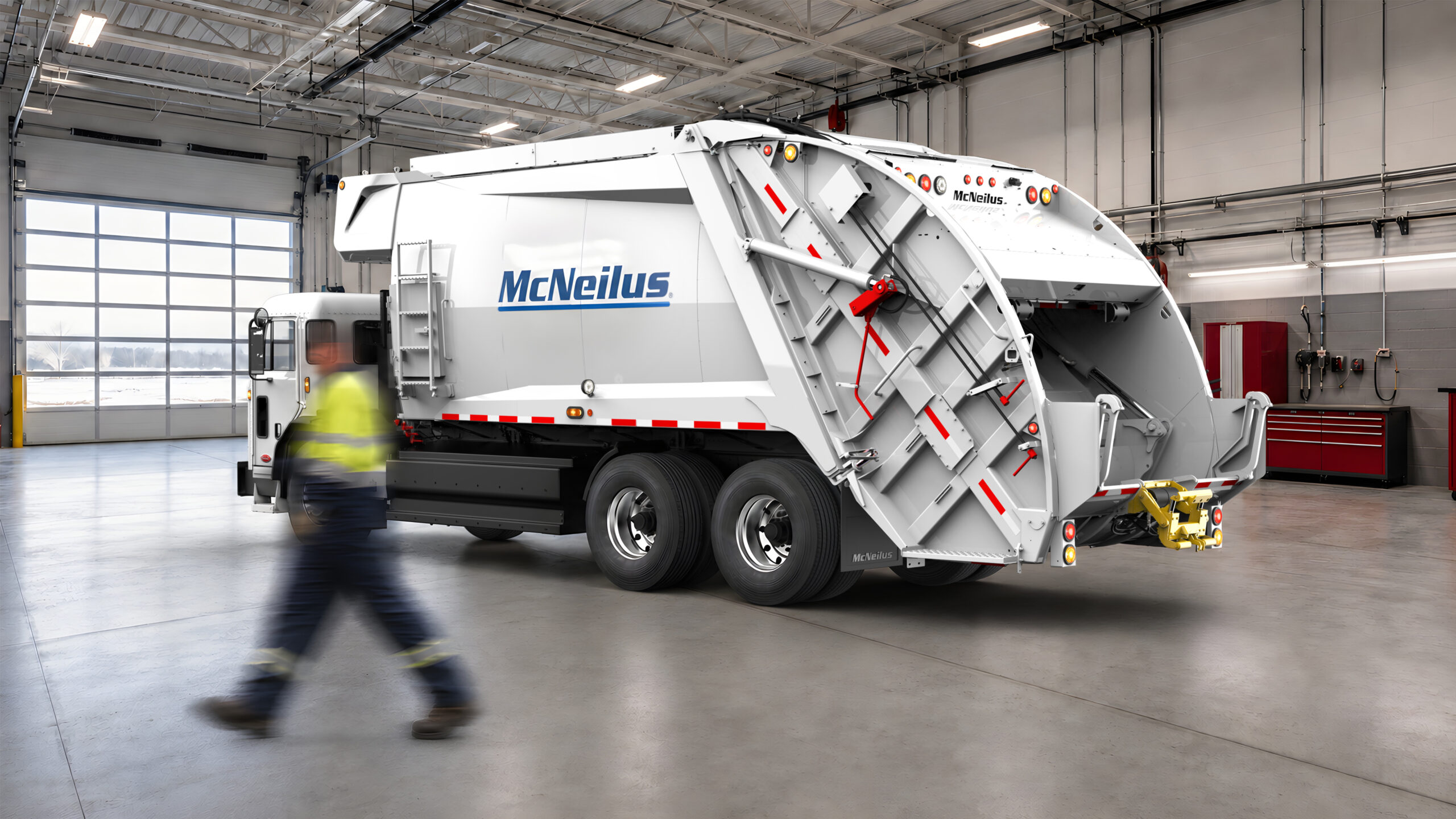
Every day, technicians work beneath refuse collection truck bodies. In most cases, everything goes smoothly. But when something goes wrong—because a body lowers unexpectedly or because a tailgate was not properly secured—the consequences can be serious or even irreversible.
This type of accident is almost always preventable. A strict procedure—the one prescribed by the manufacturer of your equipment—must be followed during every service operation. This article presents the universal principles that must be observed, regardless of the truck model being serviced.
One rule remains essential: never rely solely on the hydraulic system to keep equipment in the raised position.
Why securing the equipment is non-negotiable
When a technician must work beneath the body of a refuse collection truck or near an open tailgate, these components represent a considerable mass that could move if they are not properly supported mechanically. Safety during refuse collection truck maintenance depends on mechanically securing the body and tailgate, as well as strictly controlling all energy sources.
The most common risk scenarios are as follows:
- Accidental lowering of the body due to a loss of hydraulic pressure or a system failure
- Unintentional lowering of the tailgate during handling or an accidental startup
- Unexpected activation of the hydraulic system by another person during the service operation
The Act respecting occupational health and safety and the associated CNESST regulations require that any work equipment capable of moving be mechanically secured before a worker is exposed to it. This explicitly includes mobile hydraulic equipment such as refuse collection truck bodies.
Failure to comply with this requirement may result in penalties for the employer, but more importantly, it may cause serious injuries to the technician.
Conditions to verify before raising the body
Before beginning any body-raising procedure, ensure that the following conditions are met. These prerequisites are common to the vast majority of refuse collection truck manufacturers:
- The truck body must be empty. Never raise a loaded body; the props are designed to support the weight of the body alone, never the body and its contents.
- Park the truck on a level, stable and clear surface, with the parking brake applied.
- Install the wheel chocks.
- Place the arms and forks, where applicable, in the fully raised position in accordance with the manufacturer’s instructions.
- Apply your company’s Lockout/Tagout procedure. If your organization does not have such a procedure, refer to the applicable standards, such as OSHA 1910.147 or the Québec equivalent. This step is mandatory.
Important : An audible alarm indicating that the body is raised is a warning. It does not confirm that the body is properly supported and secured.
Body-raising and support procedure
The steps below reflect the best practices generally prescribed by refuse collection truck manufacturers. Always consult the manual specific to your model for exact details, including the controls, prop locations and securing sequence.
- Loosen the bolts on the body hold-down brackets without removing them completely, then remove the retaining plate according to the procedure specified by the manufacturer.
- Activate the power switch or battery disconnect switch in accordance with the manufacturer’s instructions.
- Raise the body using the dedicated controls, generally a body-raise button combined with a hold-to-run enable switch, until the cylinders reach the end of their stroke.
- Engage the mechanical body props: remove the retaining pins, rotate the props around the hydraulic cylinder rods and position them correctly. This procedure varies by model and may involve fixed props, removable hoist cylinders or quick-disconnect components.
- Slowly lower the body onto the props using the designated controls until the body rests completely on the mechanical supports.
- Disconnect the electrical power by placing the battery disconnect switch in the OFF position and apply the complete Lockout/Tagout procedure.
DANGER : The body props must be correctly positioned around the cylinder rods before the body is lowered. Incorrect positioning may result in serious injury or death.
Tailgate securing procedure
The rear tailgate represents a considerable mass and can cause serious injuries if it closes during a service operation. The tailgate support procedure is separate from the body support procedure and must be addressed independently.
- Start the engine and open the tailgate to the position required to clear the props
- Shut off the engine and remove the key. Apply the Lockout/Tagout procedure.
- Remove the retaining pin from the tailgate prop, rotate the prop into the engaged position over the cylinder rod and reinstall the pin to hold it in place. Repeat this operation on both sides.
- Start the engine, activate the pump and slowly lower the tailgate until the cylinder barrel rests against the face of the props. Shut off the engine.
DANGER : Never position yourself beneath a tailgate that is moving or that is not mechanically supported. Remain clear throughout the entire tailgate movement.
Caution : Never operate the hydraulic controls to force the tailgate downward against the props. Doing so could damage the supports.
Mistakes that must always be avoided
Regardless of the truck model or type of service operation, the following practices must always be prohibited:
- Working beneath a body or tailgate that is supported only by hydraulic pressure, without mechanical props
- Using improvised blocks, makeshift jacks or any other material not designed for this purpose as supports
- Leaving the ignition keys accessible or the power supply active while work is being performed beneath the body
- Working alone without another person being informed and available to respond
- Skipping steps in the procedure to save time—an accident is always more time-consuming and costly than completing the full procedure
- Failing to apply Lockout/Tagout because the service operation will only take a short time
A service operation lasting only a few minutes is still a service operation. Its short duration does not reduce the weight of the body or the potential consequences of unexpected movement.
The manufacturer’s manual remains the primary reference
This article presents the general principles of safety procedures for raising and securing refuse collection trucks. However, each model has its own specific features, including the location and type of props, lifting controls, electrical disconnect procedure and designated support points.
Each truck has its own specific features:
- The type and location of the props.
- The lifting controls.
- The support points.
- The securing sequence.
- The electrical disconnect procedure.
- The precautions specific to its configuration.
Before performing any service operation, always consult the maintenance manual specific to your unit. If you do not have the manual or have questions regarding the correct procedure for your model, contact your dealer or a certified technician.
A few minutes that can make all the difference
Properly positioning and securing the body and tailgate is the foundation of every safe service operation performed on a refuse collection truck.
Hydraulic pressure is never a substitute for proper mechanical support.
Taking a few minutes to verify the props, control the energy sources and follow the manufacturer’s procedure can prevent an accident with permanent consequences.
This content presents general prevention principles. It does not replace the manufacturer’s manual, your facility’s procedures or the applicable regulatory requirements.
